News & Briefings
Get the latest news and SOF commentary here. Your source for all news SOF since 2017.

The Resistance Operating Concept (ROC), published by the United States Special Operations Command Joint Special Operations University (USSOCOM JSOU) and the Swedish Defense University in 2020, advanced resistance planning discourse. However, its conceptualization of building resilience as primarily a preparatory activity presents critical limitations. While the ROC provides essential frameworks for understanding how societies can prepare for and carry out resistance operations when conventional deterrence and defense measures fail, it offers an incomplete picture for assessing and preparing the operational environment through network development.

The wars in Ukraine and the Middle East offer many lessons for better understanding, conducting, and countering irregular warfare.1 On October 7, 2023, the Hamas attack on Israel combined attacks on Israeli military bases near Gaza, border security infrastructure, and military communications equipment with atrocities against Israeli civilians and the taking of civilian hostages. Russia, for its part, accompanied its February 2022 invasion of Ukraine with cyberattacks, attempts to kill President Volodymyr Zelensky, and a deepfake in March 2022 to try to encourage Ukraine’s surrender. Ukraine has used guerrilla attacks, sabotage, and leadership assassinations to fight Moscow. Some combination of these and other forms of irregular warfare is likely in future conflicts.
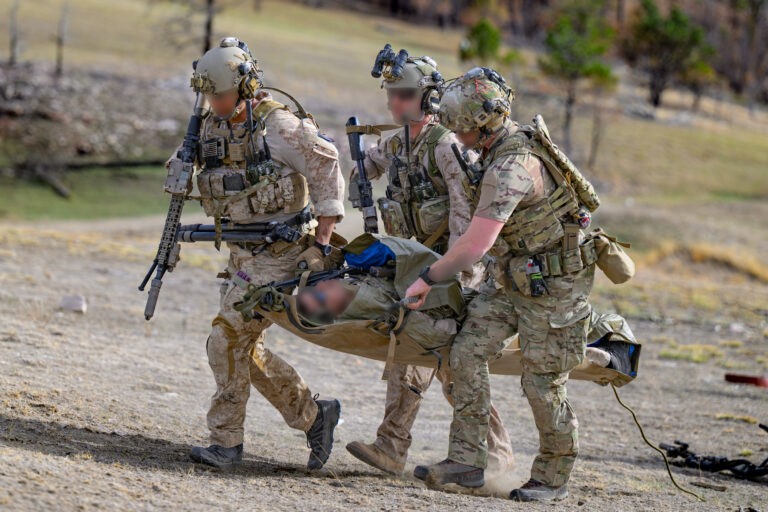
As of 2025, USSOCOM consists of approximately 70,000 Active Duty, Reserve Component, and civilian personnel assigned to its headquarters, its four components, and sub-unified commands. USSOCOM’s components are the U.S. Army Special Operations Command (USASOC), the Naval Special Warfare Command (NSWC), the Air Force Special Operations Command (AFSOC), and the Marine Forces Special Operations Command (MARSOC). The Joint Special Operations Command (JSOC) is a USSOCOM sub-unified command.

In the modern age of complex conflict, irregular warfare, and political competition, the Special Forces (SF) soldier must be more than a warrior. He must be a philosopher, strategist, and statesman who embodies the universal values of human dignity, freedom, and resilience. While the Enlightenment thinkers of the West provide one foundation for critical thinking and moral clarity, the Eastern philosophical traditions offer equally profound lessons that shape the intellectual and ethical framework of the modern SF soldier.

The special operations enterprise is facing a period of both significant change and significant opportunity. Special Operations Forces (SOF)-peculiar education, research, scholarship, and innovation will remain in increasingly high demand . JSOU is committed to being part of the solution—not just a center of learning, but a driver of innovation . To achieve this, we must ensure education and research work in tandem to equip SOF professionals with the intellectual tools needed for success

Violence in the world’s highest mountains is once again shedding light on the volatility of mountainous geography. Last May, old conflicts reignited over the disputed Kashmir region high in the Himalayan mountains. Settled only by a fragile ceasefire after a series of tense escalations between India and Pakistan, old deterrence logic has been challenged by two nuclear-armed states battling over the mountainous headwaters that feed the majority of their populations. Nearby, China continues a quiet campaign of damming and re-routing rivers in the high-altitude plains of Tibet to “steal” land from Nepal and threaten downstream countries in Southeast Asia.
No results found.
Stay Up To Date
Subscribe to Our Newsletter and Stay Up to Date with the Latest Special Operations Forces Support News and Events