News & Briefings
Get the latest news and SOF commentary here. Your source for all news SOF since 2017.

When Admiral Frank Bradley told SOF Week 2026 that the force needs “PhDs who can win a bar fight,” he was reaching back to William Donovan’s eighty-year-old framing of the OSS operator. He was right to. But the dichotomy embedded in the joke is false—and the institutional habit of treating it as real is the deepest reason the conventional pipeline keeps failing to produce what Bradley is asking for.
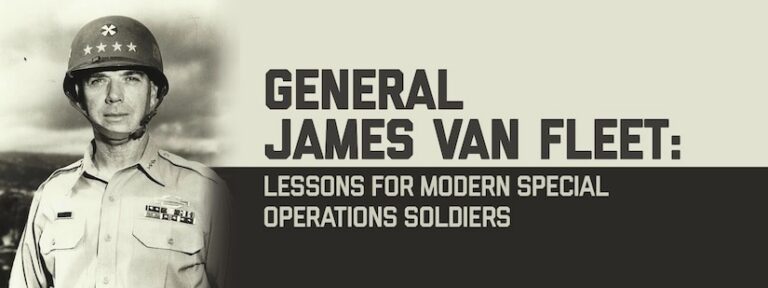
One can be forgiven for not associating Gen. James Van Fleet with special operations or Special Forces. He is best known as the commander of the U.S. Eighth Army from April 1951 to February 1953 during the Korean War. The majority of Van Fleet’s career was spent in traditional infantry roles, as a machine gun battalion commander in World War I and as a regimental, division, and corps commander during World War II. However, his assignment as head of the Joint United States Military Advisory Group, Greece (JUSMAG-Greece) in 1948, and his leadership and design of “Operation Rat Killer” during the Korean War, should grab our attention.01
Woven through contemporary debate are threads of different schools of thought that cross but lack a central thread which closes the seam. One school of thought sees a return of great power competition and argues for an emphasis on lethality and warfighting competency. Another sees a change in the character of conflict and competition where adversaries pursue their ends in the space between peace and war. Above all, and critical to stitching multiple paradigms together, is the one which is eternal in all war and immutable—the human domain. War is always a political act done by humans.
Special Operations Research: Out of the Shadows marked an important moment in the development of special operations scholarship. Published in the inaugural issue of Special Operations Journal (SOJ), which later evolved into Inter Populum: The Journal of Irregular Warfare and Special Operations, Christopher Marsh, James Kiras, and Patricia Blocksome’s article argued that special operations research remained underdeveloped despite the growing strategic importance of SOF around the world. 11 years have passed since the writing of this piece and the SOF and IW community have made incredible strides to fill this gap, though there is always room for improvement. Dr. Marsh and Dr. Kiras are the Editors-in-Chief at Inter Populum, along with Dr. Ryan Shaw of Arizona State University.
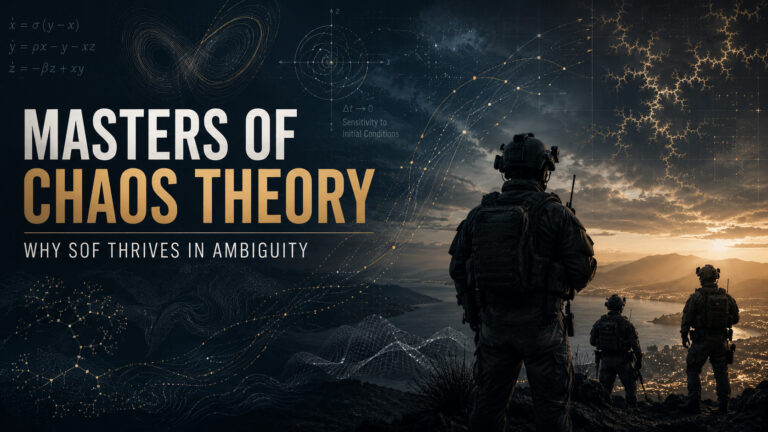
Special Operations Forces (SOF) thrive in ambiguous, chaotic environments because the principles of chaos theory directly enable and accelerate innovation in modern warfare. To understand this connection, it is important to explore the interconnections between chaos theory and innovation. This analysis defines their key principles, highlights their similarities, and shows how SOF uniquely leverages these dynamics to create operational advantages.

The convergence of artificial intelligence (AI) and non-kinetic irregular warfare (IW) represents both a qualitative shift in the nature of strategic threat and a quantitative increase in adversarial operational effectiveness. To be sure, IW has always relied upon exploitation of asymmetries of expectation, capability, attribution, legality, and response thresholds. Certainly asymmetries, and tactics like indirect approaches (e.g., employing covert and clandestine and non-kinetic operations) are factors in both regular warfare and IW. AI affords unprecedented capacity to operationalize these asymmetries and tactics at scale, and when employed within IW (often within a paradigm of “matrix operations” to coordinate exceedingly large number of participants in/across vast networks), can afford speed and precision to enable minimal cost (of resources and personnel) and augmented effectiveness of such engagements. Indeed, current peer competitors and state adversaries have explicitly recognized that strategic objectives can be achieved through persistent sub-threshold engagements that avoid triggering conventional military retaliation.
No results found.
Stay Up To Date
Subscribe to Our Newsletter and Stay Up to Date with the Latest Special Operations Forces Support News and Events