“Every intervention begins as a story of liberation. Without adaptation, it ends as a story of occupation.”
Why do militarily superior forces consistently win the fight—but lose the peace?
This is not a new question. It is the defining paradox of modern irregular warfare. From Vietnam to Afghanistan to Iraq, the United States has repeatedly demonstrated overwhelming tactical superiority, yet struggled to translate battlefield success into enduring strategic outcomes.
The explanation is not found in resources, capability, or even strategy in the traditional sense.
It is found in how we lead.
This article completes a three-part series introducing the Guerrilla Leader Theory (GLT)—a data-driven framework for understanding success in population-centric conflict. Part 1 established that effective leadership is a function of competence and connectedness. Part 2 explained why follower needs shift over time through the Risk to Follower Model.
This final installment answers the most important question: What happens when leaders fail to adapt—and how can Special Operations Forces lead better?
The answer lies in understanding the unfortunate and predictable path to failure I call the Liberator’s Dilemma—and in following the corresponding leadership model to avoid it.
The Default Path to Failure
External military intervention operations typically begin with an inherent advantage. A major success.
At the time of initial liberation, the intervening force can provide overwhelming value to the population. The liberator removes an immediate threat, restores security, and delivers a capability the partner force could not generate on its own. In this moment, the Liberator’s Utility—its perceived value to the local force and the population—is at its peak.
But this condition is inherently unstable. Over time, two opposing dynamics emerge.
First, the value of liberation begins to decay. What was once extraordinary becomes expected. Security becomes normalized. The memory of crisis fades.
Second, and more importantly, the costs of occupation begin to rise.
These costs are not theoretical. They are experienced daily:
- Cultural misalignment
- Perceived arrogance
- Civilian harm
- Constraints on autonomy
- The persistent reality of foreign presence
Individually, these frictions appear minor. Collectively, they are decisive.
As liberation’s value declines and the associated costs of occupation rise, the perceived utility of the intervening force steadily erodes.
At the same time, a local alternative—whether a political faction, militia, or insurgent movement—gains relative advantage. The local alternative possesses a critical strength the external force cannot replicate: it is indigenous. Members of the local alternative share identity, language, and cultural legitimacy with the population and the partner force.
These two trajectories are on a collision course.
The point at which the value of the liberator’s utility and the value of the local alternative intersect is the T* crisis point.
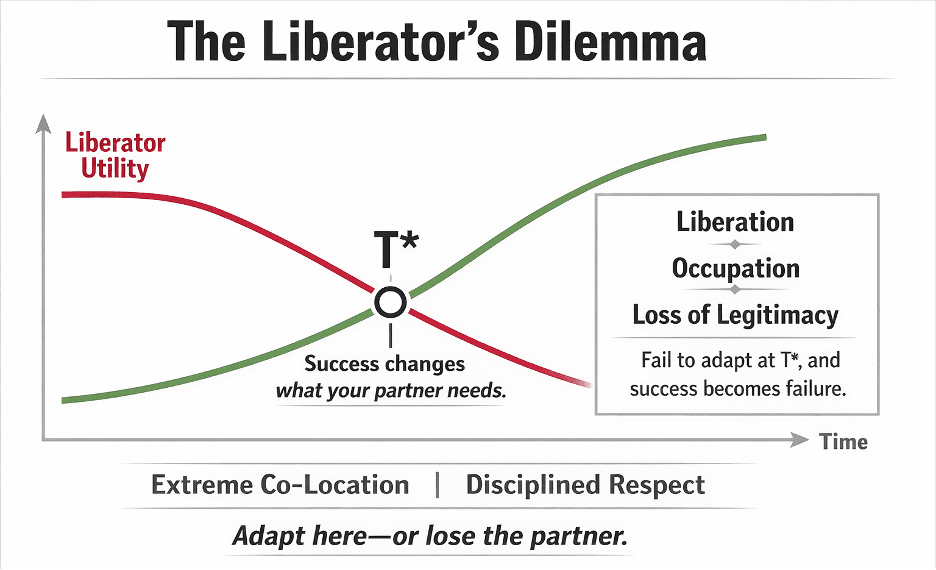
Figure 1: The Liberator’s Dilemma and T*
At T*, the external force is no longer viewed as a partner, but as an occupier. The strategic initiative shifts. Tactical success begins to generate strategic failure.
This is the Liberator’s Dilemma.
The Mechanism: When Success Changes the Rules
The Liberator’s Dilemma is not driven by incompetence. It is driven by failure to adapt.
To understand why, we must connect the dilemma to the central logic of the Risk to Follower Model:
As risk changes, followers’ needs change.
Time is not neutral in conflict. It transforms the environment.
The High-Risk Phase – Competence Dominates
At the outset of conflict, conditions are defined by existential threat. Survival is uncertain. In this environment, competence is decisive.
Leaders who can:
- Plan effectively
- Apply violence precisely
- Reduce immediate danger
become the leaders valued above all else.
This explains why disconnected but highly competent leaders—what GLT defines as “Type C” leaders—can initially succeed. Their ability to reduce risk aligns perfectly with what the partner force needs.
In this phase, competence is not just important—it is absolutely critical.
The Strategic Shift – T*
As operations succeed, risk declines.
This success produces a fundamental shift in the partner force’s priorities. Survival is no longer the sole concern as new needs emerge:
- Dignity
- Autonomy
- Respect
- Identity
This is the T* moment introduced in Part 2.
T* is not just a change in conditions—it is a change in expectations.
And it is the moment where most leaders fail.
Because the behaviors that created success to the right of T*—control, direction, technical dominance—now generate friction to the left of it.
The leader has not changed. The environment has.
The Low-Risk Phase – Connectedness Dominates
Beyond T*, competence becomes the baseline—not the differentiator.
What matters now is connectedness.
Leaders who fail to recognize this shift continue applying high-control, competence-centric approaches to a problem set that no longer exists. In doing so, they unintentionally accelerate their own decline.
The “Type C” Disconnected Expert, once indispensable, becomes a liability—not because their competence has diminished, but because its relative value to the partner force has collapsed.
This is the mechanism of failure.
It is not failure in battle that causes strategic defeat—it is the failure to recognize that success has changed the rules.
Bending the Curve: Guerrilla Leader Adaption
Succumbing to the effects of the Liberator’s Dilemma is not inevitable.
It is simply the default.
Leaders who understand Guerrilla Leadership Theory can avoid collapse by deliberately adapting at T*—shifting from a purely transactional model of leadership to one that integrates relational dominance.
This is the defining characteristic of the “Type D” Guerrilla Leader.
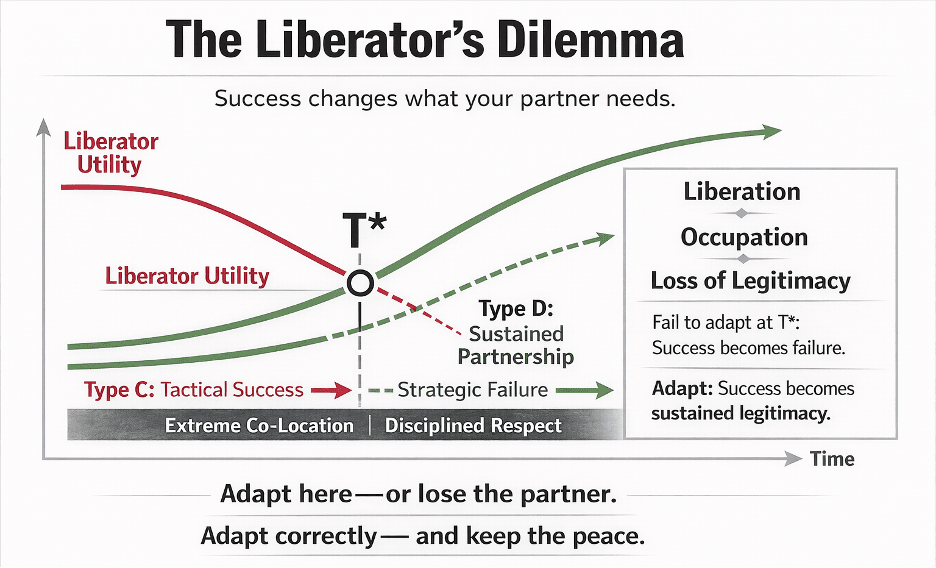
Figure 2: Bending the Curve
The solution is not to abandon competence. The solution is to supplement competence with connectedness at the moment it becomes decisive.
This requires action—not intent. This is the very moment that insecure leaders double down on competence out of fear of connectedness. This is the moment to be avoided at all costs.
From the data, two behaviors emerge as the most powerful drivers of sustained success:
- Extreme Co-Location
Proximity is power.
Leaders who physically and socially integrate with their partner force—living, operating, and sharing daily experience—eliminate the distance that defines hierarchy.
Distance is the first signal of hierarchy, and proximity is the first signal of trust.
Extreme co-location is a costly signal. It cannot be simulated or delegated. Extreme co-location communicates:
- Shared risk
- Shared identity
- Shared fate
It collapses the “us versus them” dynamic that undermines long-term partnerships.
In doing so, it transforms the relationship from transactional to relational.
2. Disciplined Respect
If proximity builds trust, respect sustains it.
Disciplined respect is not passive politeness. Disciplined respect is an actively enforced standard of behavior that governs how leaders speak, act, and frame their partners.
It requires:
- Zero tolerance for disparaging language
- Cultural awareness in decision-making
- Consistent reinforcement of partner dignity
When leading in irregular warfare, disrespect is not a cultural error—it is a strategic failure that compounds daily.
Over time, disciplined respect builds a shared identity—the foundation of connectedness in the original data.
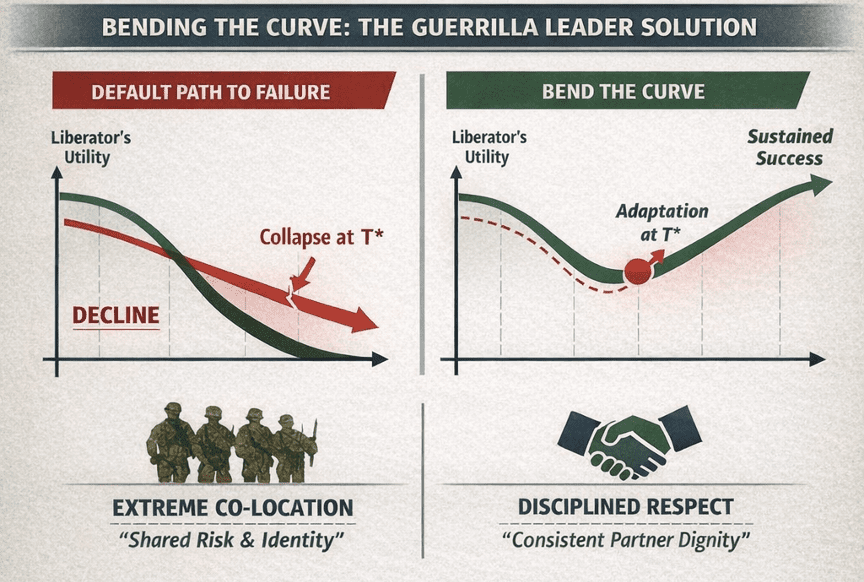
Figure 3. The Guerrilla Leader Solution
From Transactional Utility to Relational Utility
These behaviors generate a new form of value: relational utility.
Unlike transactional utility—which declines as risk decreases—relational utility compounds over time.
It offsets the rising costs of occupation. It stabilizes the leader’s perceived value. It prevents the collapse at T*.
In effect, the leader’s utility curve is no longer destined to decline.
It bends.
Implications for SOF and Leader Development
The implications of this model are direct—and often uncomfortable—in practice.
If the Guerrilla Leader Theory is correct, then the United States is not struggling in irregular warfare due to a lack of capability.
It is failing because it is systematically applying the wrong type of leadership for the complexities of population-centric warfare.
Current systems overwhelmingly prioritize:
- Tactical competence
- Technical expertise
- Individual performance
These systems are necessary—but insufficient. Competence-based leadership practice produces “Type C” leaders at scale.
Leaders who can win the fight—but are structurally predisposed to lose the peace.
If irregular warfare is fundamentally a leadership problem, then solving the problem requires changes at four levels:
Selection: We must identify leaders capable of building connectedness—not just demonstrating competence.
Training: Building connectedness must be trained as a core warfighting skill, not treated as an interpersonal byproduct.
Evaluation: Leader success must be measured not only in enemy killed or missions completed, but in partner force outcomes.
Command Climate: Units must reward integration, humility, and relational risk—not just technical dominance.
This is not a marginal adjustment. It is a strategic shift.
Conclusion: From Liberator to Partner
The Guerrilla Leader Theory provides a unified framework for understanding success in irregular warfare.
It reveals a simple but powerful truth:
Winning is a two-stage process.
First, a leader must possess the competence to survive the high-risk phase. This is the price of entry.
But success in that phase creates a new requirement.
As risk declines, the leader must evolve.
From a provider of capability to a builder of trust. From a tactical asset to a strategic partner.
Every intervention begins as a story of liberation.
Without adaptation, it ends as a story of occupation.
The solution is not found in technology, firepower, or resources.
It is found in whether the leader recognizes—and acts upon—the moment when success changes what their partner needs.
Fail to adapt at T*, and success becomes failure. Adapt, and success becomes the foundation for lasting peace.
This is how the dilemma is solved. This is how the peace is won.