
By
This article examines ubiquitous technical surveillance (UTS) as the operationalized manifestation of unrestricted warfare in contemporary strategic competition, arguing that it collapses normative assumptions of access, attribution, and initiative. It contends that the renewal of irregular warfare lies in signature reduction as a counteroffensive gray zone doctrine that preserves freedom of maneuver by centering human operational judgment under pervasive surveillance conditions.
“[Unrestricted warfare] means that all means will be in readiness, that information will be omnipresent, and the battlefield will be everywhere. It means that all weapons and technology can be superimposed at will… the boundaries lying between the two worlds of war and non-war, of military and non-military, will be totally destroyed…”
— Qiao Liang and Wang Xiangsui, Unrestricted Warfare
These prescient words were not speculative theorizing from two senior People’s Liberation Army Air Force colonels, but rather a declaration of the operational reality of strategic competition. This reality – the very operationalized manifestation of Chinese unrestricted warfare – we call ubiquitous technical surveillance (UTS). This condition has increasingly preoccupied policymakers and practitioners. The Central Intelligence Agency and its partner label UTS an “existential threat” that is persistent, pervasive, and increasingly automated across all domains. It has collapsed the crucial boundaries between war and non-war, and our traditional assumptions of access, attribution, and operational initiative along with it.
Yet it is precisely in this collapse – what we call gray zone warfare – where we find a renewal of irregular warfare. Most notably, we look to signature reduction which keeps the human person and his or her operational judgment at its core.
Unrestricted Warfare: Understanding Strategic Competition
Unrestricted warfare prompts the questions, “Does a single ‘hacker’ attack count as a hostile act or not? Can using financial instruments to destroy a country’s economy be seen as a battle? Where is the battlefield?” The answer is: Everywhere.
The United States certainly strives to maintain its relative technological advantage and commensurate capacity for precise and effective military power projection as an instrument of statecraft when it chooses to do so. Yet what lies beyond this normative comfort zone – characterized by precision strikes, commercialized cutting-edge tech, and centralized control – is the growth potential for irregular warfare, and thus, a form of warfare which yields stable, consistent, scalable, and effective strategic effects.
The face of this growth potential in irregular warfare is signature reduction, the gray zone counteroffensive to the operational condition of UTS in unrestricted warfare. Whereas UTS persistently and pervasively challenges cross-dominance in strategic competition spaces, signature reduction offers a scalable counteroffensive which yields freedom of maneuver within it.
Signature Reduction: Freedom of Maneuver In The Gray Zzone
Unrestricted warfare directly confronts freedom of maneuver: It builds and maintains global surveillance networks, supports algorithmic targeting and correlation, aggregates data at-scale, and rapidly diffuses technology at exponential financial – and we would add, psychological and other – cost. This condition presents a highly adversarial and offensive pressure across domains, and the risk to the mission and force skyrockets while operational effectiveness suffers.
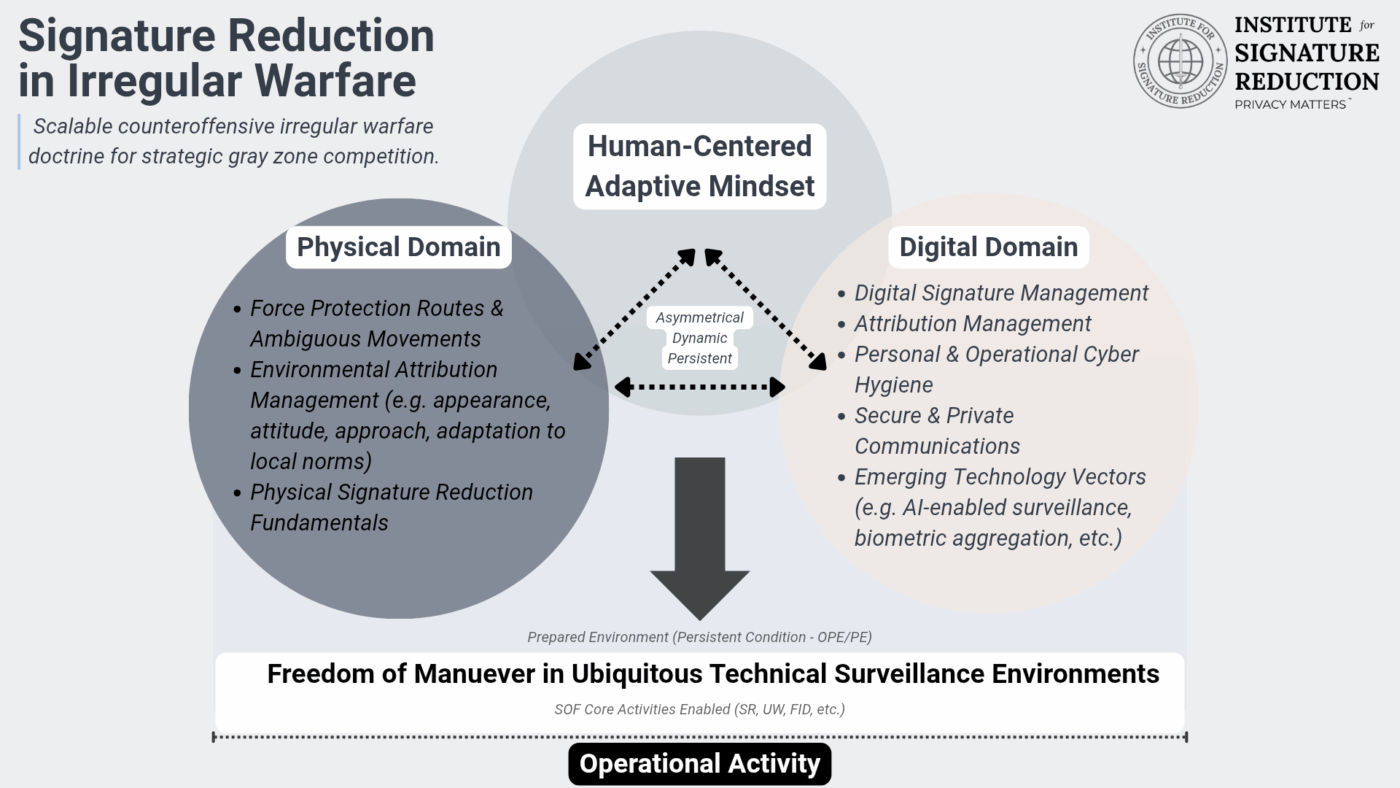
Figure 1: As ubiquitous technical surveillance collapses traditional assumptions of anoymity and access, signature reduction provides a human-centered, cross-domain doctrine that restores freedom of maneuver and operational initiative in gray zone competition.
When the battlefield is everywhere, and operational impact can be achieved by accessing, monitoring, or otherwise leveraging omnipresent information across online, electronic, visual-physical, financial, or travel vectors, nowhere is safe. Risk overwhelms and shuts down initiative, and strategic advantage deteriorates. Whether from one’s internet search history, extensive networked CCTVs, or end-user device signatures, ordinary behavior – anywhere – becomes persistent, analyzable, and exploitable.
The strategic scenario appears highly challenging: When traditional norms of access, attribution, and operational initiative are challenged under such conditions, how can we meaningfully operate at scale to compete strategically?
With the end of freedom of maneuver in mind, signature reduction is the counteroffensive gray zone corollary to the challenge posed by UTS. Proper understanding of the doctrine yields meaningful competition with strategic effects. Signature reduction integrates distinct but complementary disciplines across both the physical and digital domains, synthesizing the fundamental aspects of irregular warfare at the level of the individual operator and his or her operational judgment.
The Human Difference In Irregular Warfare
It is precisely the human factor in irregular warfare that cannot be substituted by technological progress or prowess. Human judgment is the point at which detection risk, attribution, and behavior are continuously assessed and deliberately shaped to preserve initiative in the operational environment. No other faculty or capability exists with which to meaningfully and consistently synthesize the complexities of the contemporary operating environment, where the “battlefield is everywhere”.
Should the efficacy and primacy of human judgment be diminished in favor of technology, theorists and practitioners alike will find themselves immobilized through insurmountable risk to mission and force. We will be quickly overwhelmed by the cross-domain pressure of UTS, amplified within the strategic-level ecosystems that make it possible and upon which the premises of unrestricted warfare are founded, namely, the availability, access, and attribution potential of omnipresent information. Yet, for all its pressure, correlation does not equal understanding.
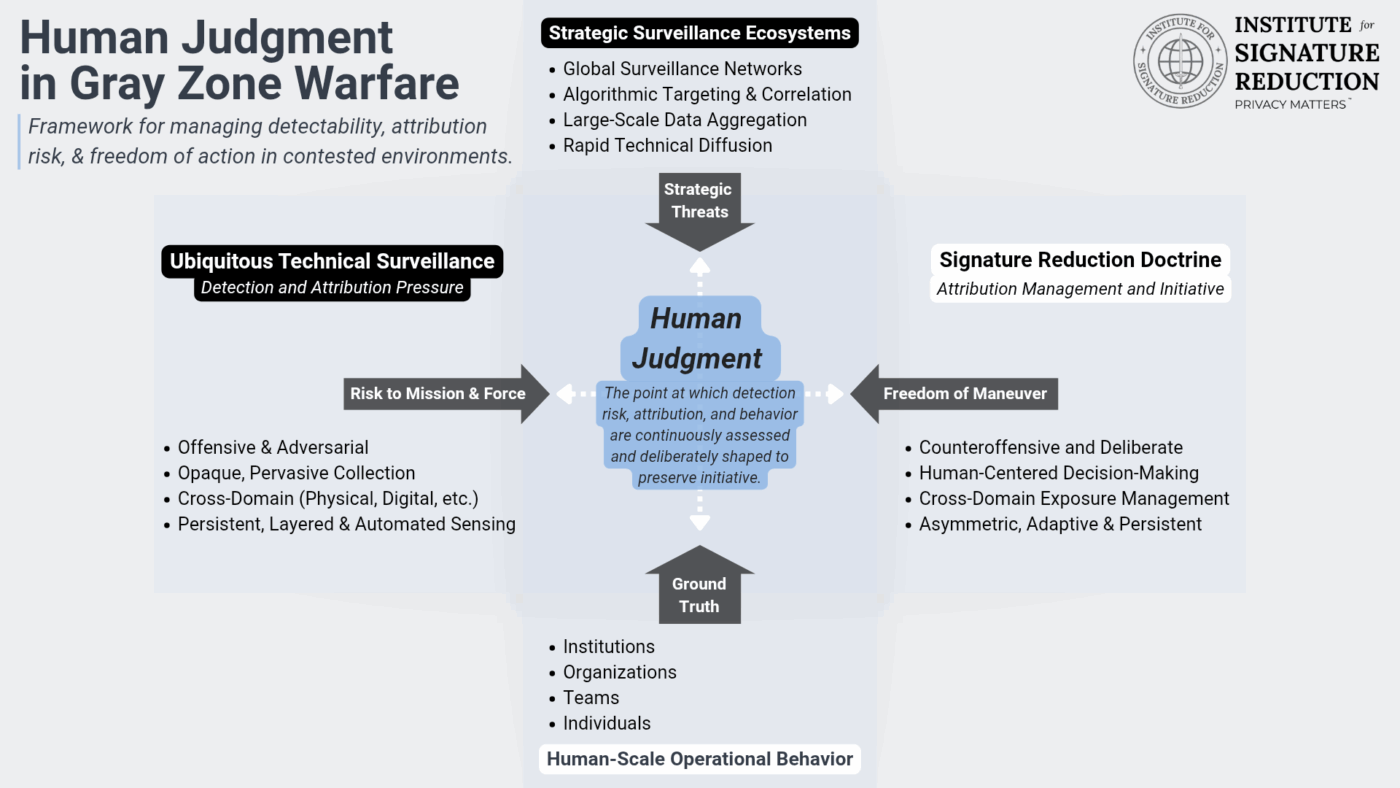
Figure 2: Under conditions of ubiquitous technical surveillance, doctrine and technology cannot substitute for judgement. This figure illustrates human judgement as the integrating function across uncertainty, exposure, time, and action-precisely the conditions imposed by UTS.
The conditions of the UTS environment are characterized by at-scale surveillance, which yields tremendous attribution pressure. It is only human judgment at-scale, through signature reduction doctrine, which properly joins and counters these conditions. Effective and sustainable freedom of maneuver is not attainable through more tradecraft, nor through incremental developmental technology arms races alone – though both are necessary and valuable aspects of viable competition.
Human Judgment As The Decisive Terrain In Strategic Competition
Operational initiative is a direct consequence of human judgment under pressure. Adversarial understanding demands the destruction of all boundaries between the two worlds of war and non-war, of military and non-military. Our respectively limited, and narrow understanding of the decisive value of technology is thus exposed: How do we overcome the pressure of the UTS environment? How long can we maintain a technological advantage? At what cost does this advantage come?
Strategic competitive advantage, however, is not derived from initiative applied to the fastest production cycles or largest valuations but to the clearest operational judgment in the operating environment in accordance with the ground truth.
The strengthening of this atrophied capacity lies in foundational signature reduction training standards maintained by the Irregular Warfare Center (IWC) as the DoDI 3000.07-appointed governmental doctrinal steward. Establishing this foundation must be in collaboration with public and private partners for relevant enterprise-wide effects.
Formal training standards and continued doctrinal development of signature reduction will prove a modest yet indispensable cornerstone of irregular warfare adaptation to strategic competition requirements. Under conditions of ubiquitous surveillance, the decisive terrain is no longer technical alone – it is operational initiative generated by and through human judgment amidst the pressures of the operational environment.